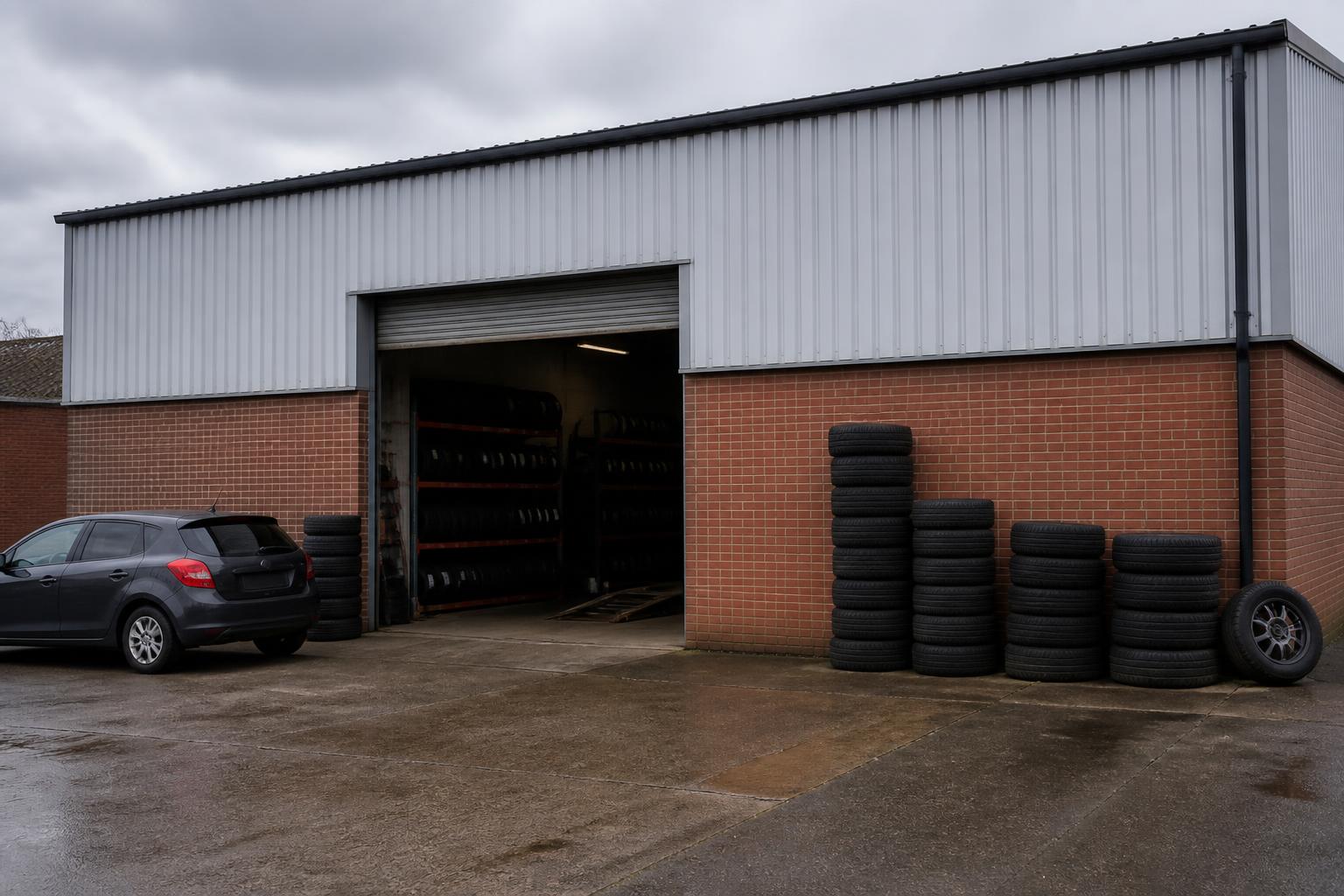
Nearly every week somebody pulls onto the forecourt on Broad Road, winds the window down and asks the same thing: how low can I actually go before it's a problem? Fair question. Tyres are not cheap, nobody wants to bin one early, and the internet will happily give you five different answers in about nine seconds.
So here is the straight version, the one we give people standing next to the car with a gauge in our hand.
The law says 1.6mm, and it is stricter than most people think
The legal minimum tread depth for a car in the UK is 1.6mm. That is not 1.6mm somewhere on the tyre, it is 1.6mm across the central three quarters of the tread width, and it has to be there all the way round the circumference. So a tyre with 4mm in the middle and bald shoulders can still be illegal, and we see that more often than you would expect.
Get caught under the limit and you are looking at a fine and penalty points per tyre. Four bad tyres, and you are in genuinely serious territory, licence included. The MOT tester uses the same rule, so anything close to the line at test time is coming back as a fail or an advisory that will bite you next year.
One thing people forget: the spare. If you are running a full-size spare, it has to be legal too the moment it goes on the car. Plenty of people limp home on a spare that has been sitting under the boot floor since 2014.
How to check your tread on the driveway, no gauge needed
Look into the main grooves that run round the tyre and you will spot small raised blocks of rubber sitting in the bottom of them. Those are the tread wear indicators, and they are moulded in at exactly 1.6mm. When the tread surface has worn down level with those bars, the tyre is finished. No measuring, no guessing.
If you cannot find them, the 20p test does the job. Put a 20p coin into the main groove. If the outer band around the edge of the coin is hidden, you have got a decent amount of tread left. If you can see that band, the tyre is getting close to the limit and needs somebody to look at it properly.
Do it in three places across the width of each tyre: inner edge, middle, outer edge. That takes about two minutes for the whole car and tells you far more than a quick glance ever will, because a tyre almost never wears evenly.
Why we usually say change at around 3mm
Here is the bit that matters more than the legal number. Tread has one main job in the wet, and that is shifting water out from under the tyre so the rubber can actually touch the tarmac. Shallow grooves move less water. It is that simple.
Braking distance in the rain does not creep up gradually and politely, it starts stretching out noticeably once you drop below about 3mm, and it gets worse fast after that. Independent testing has been showing the same pattern for years: a tyre at the legal limit can need a good chunk more distance to stop on a wet road than the same tyre with plenty of tread on it.
Put that in local terms. Coming down the A120 towards the Galleys Corner junction in heavy rain, with the spray off a lorry in front of you, that extra distance is measured in car lengths, not centimetres. That is the entire argument. We are not trying to sell you a tyre a year early, we are saying the last 1.4mm of a tyre's life is the worst part of it, and it is the part you are relying on in the weather where you need grip most.
In summer, on dry roads, a tyre at 2mm will feel absolutely fine. That is exactly why it catches people out in November.
Uneven wear tells you what is really wrong
When we measure a set of tyres, the pattern of the wear usually tells the story before the driver does.
Worn on both outer edges with a healthy middle, and you have been running them underinflated. Worn strip straight down the centre, they have been overinflated, often after a garage put in whatever pressure they felt like. Worn on one edge only, that is almost always alignment. Scalloped or cupped patches around the tyre point at worn suspension components rather than the tyre itself.
Run your hand across the tread too, gently, in the direction of travel. If it feels smooth one way and sharp and feathered the other, your tracking is out. That is a five second check that saves a lot of money, because feathered wear will chew through a brand new tyre in a few thousand miles if you fit one without fixing the cause.
Tread is not the only thing that ends a tyre
A tyre can be legal on depth and still not fit to use. Sidewall bulges mean the internal structure has failed, usually after a kerb or a pothole, and there is no repair for that. Cuts deep enough to show cord, the same. Cracking across the shoulder blocks on a low mileage car is age rather than wear, and rubber does harden and lose grip as it gets old regardless of how good the tread looks.
Every tyre has a four digit date code on the sidewall after the letters DOT. First two digits are the week, last two the year, so 3222 means the 32nd week of 2022. Once a tyre is past about ten years old we would want it off the car, and if it is on a caravan or a trailer that sits still most of the year, sooner than that.
How long should a set actually last?
There is no honest single answer, but for a typical family car doing a mix of Braintree town driving and A12 runs, front tyres often go somewhere between 15,000 and 25,000 miles and rears last longer on a front wheel drive car. Heavy right foot, lots of roundabouts, a car full of kids and shopping, cheap tyres fitted to a heavy vehicle, all of that pulls the number down.
The single biggest thing you control is pressure. Check it monthly, cold, against the sticker in the driver's door shut or the fuel flap, not against whatever the tyre says on the sidewall, because that number is the maximum the tyre can take rather than what your car wants. Underinflated tyres wear their edges away, run hot, and cost you fuel every mile.
What we do when you drive in
We measure all four properly with a depth gauge, inner, middle and outer, check the pressures, and look over the sidewalls. Then we tell you what we found. If you have got 4mm all round and nothing nasty going on, you get told to come back in a few months and you drive away without spending anything, which happens most days.
If one is close, we will show you the gauge reading rather than just telling you it is worn out. You can see the number for yourself and decide. That is how we would want to be treated.
Free tread and pressure check, Monday to Saturday between 9am and 6pm at the workshop on Broad Road. No appointment, no pressure, and if you would rather ask first, ring 01376 433951 and describe what the car is doing.